Showing posts with label Collectable Games. Show all posts

Wednesday, 30 May 2012

Dakka! Dakka! Dakka!

To the young wargamer today, the title of this post might lead them to believe that it was about some sort of Ork Fighter Bomber for Warhammer 40K.

Well sorry to disappoint them.

Those of us "older" wargamers and film buffs will know it's that immortal line uttered by Robert Shaw in the classic 1969 film "The Battle of Britain" where he is trying to teach the rookie Pilot how to stay alive during the impending battle.(due to  YouTube rules you'll have to click on the link to go to YouTube)


Regular readers will know how keen I am on the Wings of War game (now known as Wings of Glory produced by Ares Games ) but this has always been the WW1 version of the game, I had never played the WW2 version. Given the new starter set for the WW2 Wings of  Glory is about £50 I have been swithering as to the affordability of it given that I'm still keen to pick up the WW1 models.

However, an alternative system which has just been released in the last couple of months by Wizards of the Coast (WotC) is their Axis and Allies Angels 20 game

Now there will be some of you who will go "Wizards of the Coast? Bah humbug - it'll just be another card game like Magic the Whatchamacallit or role playing game like Dungeons and Doldrums".

Now, fortunately from my point of view I play/ have played both "Magic the Gathering" and "Dungeons and Dragons" and enjoyed them both so the fact that Angels 20 is produced by WotC wasn't cause for alarm. And their WW2 sea battles and WW2 land battles versions have been incredibly popular, although admittedly I hadn't played any of these.

Plus the models for Angels 20 are pre-painted. So that was another reason to be interested. 

The starter set normally retails for about £25 but can be had on Amazon for a lot less than this, so last week Alan and I started down another slippery slope with our first game.


Flt. Lt. Rupert Chumley-Brown in his Spitfire leading his
spiffing good mate, Flt. Lt. Horace Plumpington in his Hurricane head on to meet the Hun.


As you will note from the picture the game is played on a hex map. The starter set comes with 2 map sheets that can be butted together to form a decent sized playing area. Each type of plane has a stat card which contains all of the essential information the pilot needs to fly his kite.


So looking at the card above Rupert (who is an Ace) and his Spitfire cost 46 points . At normal speed he can move a minimum of 2 hexes and a maximum of 4 hexes and at high speed can move 5 hexes. At Range 1 he rolls 6d6 (that's code for 6 x 6 sided dice) to attack, Range 2, 4d6 and at Range 3, 2d6. Rupert's Spit can take a total of 3 hits before hitting the deck and a hit is scored if his armour damage score of 3 is equalled or exceeded when fired upon by an enemy aircraft. However, if the Vital score of 6 is scored in one attack then catastrophic damage is caused and Rupert is a goner. When a plane has 1 hit point left then it is deemed to be crippled and that is bad news.

Then you have the bonus scores that can be added to 2d6 whenever Rupert wants to attempt a "difficult manoeuvre", the bonus to be added dependant on whether the manoeuvre is a type of Turn, Roll, Climb or Dive.

Finally, there are a couple of Special Abilities which Rupert can use during the game.


Here Come The Hun!

Alan was flying as Jerry while I took the good old Brits!

Each player at the start of the turn rolls for Initiative. The player with the highest score gets to move second and will always move one of his planes last - a very important advantage when you are trying to get on an opponent's tail. First player moves one of his planes, then the Second Player moves one of his planes and so on until all planes have been moved as long as the Player who won initiative moves the last plane in the turn.

During the plane's movement it can attempt to make 1 "difficult manoeuvre" per turn (some Aces can attempt 2 such manoeuvres). At normal speed the score to equal or exceed with 2d6 and adding the plane's relevant bonus is 10 and at high speed the score to equal is 13. Failure to get that score and the plane will normally just fly straight ahead into the next hex.

Once all planes have moved then the First player can attack with any of his aircraft that has a valid target (usually within 3 hexes of the front of the aircraft, although the Me110 can fire up to 4 hexes away) and under the basic rules both planes have to be at the same altitude (there are 6 altitude bands and there are  numbers appearing on the base of each plane which designate the altitude the plane is flying at and you simply swivel the plane round so that the front of the plane is above the relevant number).


I won the initiative for the first turn, so Alan moved one of his planes first. It wasn't long before we were all in amongst each other and Alan, being Alan, decides he was going to try and fly Emil in his Me109E into Rupert..


If 2 planes fly into the same hex and are at the same altitude then a collision may occur. Both players roll a d6 and if both roll a "1" (or if the plane's pilot is a rookie then "1" or "2") then a collision occurs and BOOM! So we both rolled our dice, I rolled the black one....


The "Eye of Sauron" rolled by Alan is a "1"

So thankfully no collision but the sky was getting crowded as we both tried to manoeuvre our kites into a good firing position.


Then Horace takes a 2 hex range burst at Friedrich in the Me109F and scores 1 hit!


You can just see the red hit counter under Friedrich's tail. Don't ask what Alan's Ace is trying to do!

Alan then gets an attack on Rupert at range 1 but approaching from 10 o'clock needs "6's" to score damage.


And misses!!

Rupert, however, showing true flying ability gets into Emil's 8o'clock arc


Dakka! Dakka! Dakka! A hit!

Realising they were up against a top notch pilot, the Jerries do the dastardly thing and pick on Horace in his Hurri


Boo Hiss! The Jerries manage to scratch Horace's paintwork.

Rupert tries to break up the Party by targeting Friedrich, who is continuing to tail Horace in his Hurri


But leaves himself exposed to sneaky Emil to get in a close range burst

Friedrich's relentless pursuit of Horace in his Hurri leads Rupert to risk all to try and save his mate 


And Friedrich, already on 2 hits is a Goner!! Pip! Pip! Rupert!

But by concentrating on Friedrich, Rupert for a split second forgets to check the skies for Emil, but too late!


"Cripes! Jerry has got me! Bail out and hope the chute works!"

By this time Horace and his Hurri were also in a crippled state and a crippled Hurri is no match for a sneaky Hun.


Typical Jerry overkill scoring 6 hits when only 3 were required!


"Bail out Horace!"

So a lucky win to Alan in the first game. However, rather than try and prove it was no fluke, he made way for his lad Josef, and those of you who have read about our Saga/ Blood Bowl or any other games that involves dice will know that when Josef rolls dice, he takes no prisoners.

Josef, elected to take the Brits this time, leaving me with the dastardly Huns. Instead of the Me109F, I took another Me109E and we set to the skies. However, before I knew it, Josef's Spit managed to get on the tail of my Ace. 


With, 1 damage point already, I expected to have a crippled kite at the end of the attack. However, a Me109E only has a score of 5 for it's vital score, so Josef, being Josef rolls 6 dice needing 4's....


And scores a total of 6 hits blowing the Me109 out of the sky!


"Gott in Himmel!"
(The camera wobble was due to me shaking my head in disbelief at Josef's jammy rolling")

Josef then swooped in for the kill against the other Me109


"Achtung Spitfeuer!"

And the result was alas inevitable....


Scratch another Hun.

The game with Josef lasted, I think about 4 turns, I was too dazed too remember the actual total.

So a couple of entertaining games. Okay, it may not appeal to the purist but the fact that all you need is the starter set and you can literally start playing as soon as you open the box is a major plus point for me (although the fact that it uses dice means it doesn't get a maximum 10 out of 10 score).

As you can hopefully see from the pictures the models are not bad at all. The game is marketed as a "collectible" game in that the initial set has 31 different planes, representing, British, American, Russian, French, German, Japanese, Finnish and Chinese aircraft and the additional planes can be bought in "boosters" containing 3 random models so there is always the possibility of ending up with a model you already have. But then you can always trade it for one you don't have or build up that squadron of Hurricanes!

The Me110 model is, however, only available in the starter set and all the stat cards are in the starter set, not in the boosters. There is already a market on EBay for single models if you want to be specific about the planes you need.

I liked the game a lot. The rules were pretty simple to follow and once we got the hang of what the different manoeuvres would do to the position of the plane then it did become very tactical. There are suggested scenarios for the Battle of Britain and also a scenario generator to play 1 of 6 different scenarios. Advanced rules make it possible to fire at aircraft 1 altitude band below or above you, and to get bonuses to your attacks and manoeuvres depending on how you position your plane on it's stand. It also introduces weather rules and fairly simple rules for ack-ack.

Further sets will no doubt be released and which will introduce more aircraft types (the word on the street is that the next set will be Pacific themed) and if it follows the usual WotC format you can probably expect 3 different sets in a year.

So definitely sliding down another slippery slope.......

(It was not all bad news that night, I whupped Alan's butt at Wings of War!)

Saturday, 16 April 2011

Thunderstone - Or "Where's My Hero's Bloody Sword when I need it?!!"

So Thursday night Ruarok and I headed up to Alan's house - a couple of games of Nightfall were first up. It was Ruarok's first time playing the game and he seemed to pick up the mechanics pretty well and after my epic play of last week, normal service was resumed this week, especially in the last game where I ended up with a massive 19 wounds compared to the 4 received by Alan's son, Joseph, which is the lowest total I've seen in the 6 games I have played so far, so well done to him (Alan won the first game but we'll not dwell on that....)

The main event of the evening though was another new (to me anyway) deckbuilding card game - Thunderstone, again by Alderac Entertainment Group (AEC).


The premise behind this game is that each player is trying to build up a party of adventurers, complete with various bits of kit which will help them defeat the denizens of the Grimhold Dungeon. Unlike Nightfall though, there is no player v player action, this is a game where it is pretty much the player against the game.

No board is involved, just the cards and these are made of good quality card stock and seem fairly durable although I would always look to sleeve them.

The game sets up by creating the "Dungeon" and the "Village", in this case "Barrowsdale". First the Dungeon is set up by randomly selecting 3 cards  from the "Monster Randomizer cards". There are 8 different types of Monster in the starting deck and each type has 10 Monsters available. The Monster types selected then form the creatures of the dungeon, which are shuffled and then 10 counted off. To these 10 is added the Thunderstone card, they are shuffled again and placed under the other 20 Monster cards. The top 3 cards are then revealed and these are the starting Monsters that the players will have to combat and are deemed to be in Ranks, 1, 2 and 3 (representing deeper levels of the dungeon, the deeper you get, the darker it gets, the more penalties in combat you may suffer). As a Monster is defeated or is moved up the levels of the Dungeon, another Monster card is revealed from the Top of the Dungeon Deck. If the Thunderstone card is revealed and is then in moved to Rank 1, the game ends and the winner is determined by the Number of Victory points the player has accumulated.


From a selection of 11 different Hero types, 4 are randomly selected, these are the Heroes that will be available for the players to hire and aid them in their quest and can be recruited from the Village. There are 3 Levels for each Hero, as experience is gained (by killing Monsters) the Hero can be levelled up, to a maximum of Level 3.

The 4 Heroes for our game

The rest of the Village is then created. The 4 basic Village cards, Militia, Dagger, Iron Rations and Torch, are always in play in each game. 8 cards are drawn from the "Village Randomizer deck" and those items, characters, spells, are placed in the Village, along with the basic cards and the Heroes, so that the Table will look something like this -

(c) Boardgamegeek

Each player then draws 6 Militia cards, 2 Dagger Cards, 2 Iron Rations and 2 Torches, which form the player's starting draw deck, 6 cards are then drawn to form your hand and then you randomly decide who starts. As cards are discarded into your discard pile, when your draw deck is empty the discard pile is then shuffled and becomes your new draw deck thus ensuring the recycling of cards into your hand

The use of the Randomizer cards is a nice mechanic ensuring, quite literally that no 2 games will be the same.

So we started.

Each player in his turn has the choice of visiting the Village, Entering the Dungeon or resting. In both the case of visiting the Village and Entering the Dungeon once you had performed the relevant actions in that area, any of your undestroyed cards in play or in hand are discarded to your discard pile and another 6 cards drawn, so this, in theory, helps you recycle cards and get them into your Hand.

We were slightly unlucky in that the 3 monsters guarding at the start of the game were all pretty tough, with a Tormentor (health of 8) occupying the Rank 1 slot. Combat is pretty straight forward, you add up all of the attack factors available from the cards in your hand. If this figure is equal to or greater than the monster's health then the monster is defeated. The defeated monster is then placed in your discard pile (it may have a gold value which can be cashed in once the card is in your hand). You also receive a number of XP's for defeating the monster and some of them also generate the all important Victory Points for winning the game. However, there is also a penalty applied for fighting underground in a dark, dank dungeon. A dark penalty of twice the Dungeon rank is applied to the combat so at Rank 1 the penalty is -2, at Rank 2, it is -4 and Rank 3, it is -6. The Dark penalty, can be modified by the use of items/ cards/ spells that generate a "Light" factor, for example, a Torch.

One feature that I found slightly odd was that there did not appear to be any penalty in taking on a Monster and being defeated by it. Some Monsters have effects which can lead to negative things happening to your party, but they would take place regardless of the success or failure of the Player's attack. However, the main reason for attacking a Monster is that if it is not killed, it doesn't stay in the Rank, instead it is returned to the bottom of the Monster deck and any Monster in the Rank below is moved up a rank to take the original Monster's space and a new Monster is revealed from the Monster deck and takes it's place in the Dungeon. It took us a wee while to realise this and thus the game could have perhaps proceeded a bit faster than it did.

My first hand of 6 cards was a pretty poor mix of Militia, rations and torches, no daggers so no combat bonus available to the Militia and therefore no way to take out any of the starting monsters, so my only option was to visit the Village to try and either recruit Village Folk, items/ weapons or spells or Heroes. To do this you "cash in" appropriate cards in your hand, that is, if the card in hand has a gold value it can be cashed in for that value (the cashed in cards are placed on your discard pile) and once you have generated enough gold for the card of your choice from the options available in the Village, you take the relevant card and place it in your discard pile. Normally you can only purchase 1 cards per turn although playing the Barkeep card will allow you to purchase and additional card.


Unfortunately, even as I added different cards to my deck, I still found it impossible to get the right mix of cards which would allow me to take on a dungeon monster. Cards can be destroyed which may generate extra gold or combat effects (for example, see the text on the Spear card above) and once destroyed they do not return to play, so careful decisions have to be made as to when to destroy a card, and which one. The others, in the meantime were making a flying start, Ruarok in particular and before long he was killing monsters and with the earned Experience Points he was levelling up his Heroes.

By the time the Thunderstone was revealed and had made it's way to Rank 1 of the Dungeon, I had earned a grand total of 4 Victory points and had not been able to Level up a single Hero. I just hadn't been buying enough weapons to give my Characters enough bonuses in Combat to win their fights and thus get the all important Victory Points. Other players are not allowed to help you with the play of their cards in hand, you are very much on your own.

Fortunately, we didn't meet these Bad boys but then again, I couldn't take out a lowly Goblin.

So the Thunderstone was moved to Rank 1 and the game ended, I was a resounding last place whereas Ruarok , was a pretty convincing winner.

So again an enjoyable game despite my abject failure with my deck build , we picked up the Game mechanics reasonably quickly and I think subsequent games will move along much quicker now that we know how it works although of course, there will still be the many choices to be made as to what cards to purchase for your deck and getting the balance right between the number of characters in your deck and the items/ spells and weapons available to them to use in combat.

A number of stand alone expansions have now been released for the game, which Alan is already making mutters about purchasing so I've no doubt we will be re-visiting this one again. I do feel the need to be playing with some miniatures again, starting to get some withdrawal symptoms now......

Saturday, 9 April 2011

Fangs for the Munchies


Nightfall by Alderac Entertainment Group is described as a "competitive deckbuilding game". To be honest I had never heard it of it before until a few nights back when my mate Alan announced he had bought the game and he was expecting it to arrive for our gaming session on Thursday night.  So although I was bringing along my Orc Blood Bowl team for some anticipated mayhem on the Blood Bowl pitch, Alan had asked if we could give Nightfall a try out before we started playing BB. It would only take about 45 mins he said, and he also mentioned that his son, Joseph, who is 9, was also keen to give it a try, so having had a quick look on BoardGameGeek as to what the game was about I said, no problem, we'd give it a go before we started the Blood Bowl.

I've played a few Card Games over the years. I first played Magic The Gathering when the Tempest Cycle set was in play in 1997 and stuck around with it for a few years until, the volume of expansions and card releases just overwhelmed me and I couln't keep up (I tend to be a collector as well as a player and it soon became apparent that there was no way I was going to be able to collect every card - and having half completed sets always annoyed me). However, what really killed off Magic for me was the arrival of the now sadly defunct Lord Of the Rings TCG by Decipher.

I had signed up to part of Decipher's "Riders" programme, which meant I would set up demo games, show people how to play the game and run tournaments and for a while it too sucked up a lot of my time, but although with Lord of the Rings I had been able to complete the first 10 sets of the series, work, new daughter and other real life issues meant I just couldn't keep at it. That and the fact the rules went through such a radical transition that the game when I left it was very different from the one I had started playing.

Ruarok, went through a phase of playing Pokemon Cards (with the original sets - not all these new fangled sets that seem to come out once a week) and again we played that regularly for a wee while. But, the recurring problem of being tempted to collect all the cards in the sets brought about impending bankruptcy so it too went by the wayside.

So I stayed in the TCG wilderness for several years until, quite suddenly and unexpectedly, while on holiday last year, I picked up the starter decks for the new edition of Magic, 11th Edition or M11. Played some games with Ruarok, bought a pile of old cards bringing back the memories of the late, great sets of Alliances, Mirage, Tempest and Urza's Saga and so on (and also bringing with it a painful realisation that I had practically given away my old cards - "Mox Diamond" anyone?") but the buzz for card games didn't really hit home this time and so far I've resisted the temptation to go mad on collecting the cards again.

Alan told me that Nightfall was different. It is a boxed set, and all of the cards in the set are in the box - so in theory you only need the one box to play with. Although expansions are planned for the future they will be, again, fixed sets, so each box has exactly the same cards as the next box on the shelf - no more scouring eBay for that elusive power card. I understand it's what is called a "Living Card Game". He also mentioned that one of our old mates, my Lord of the Rings TCG nemesis, Mark Wootton, was involved in the game design. Mark had been heavily involved with the Legend of the Five Rings (Lo5R) TCG (which I admit I never played) and I think I am right in saying that he was involved in the design of some of the later Lo5R sets so the fact that he was involved in the design of Nightfall gave me some indication that the game would be solid.

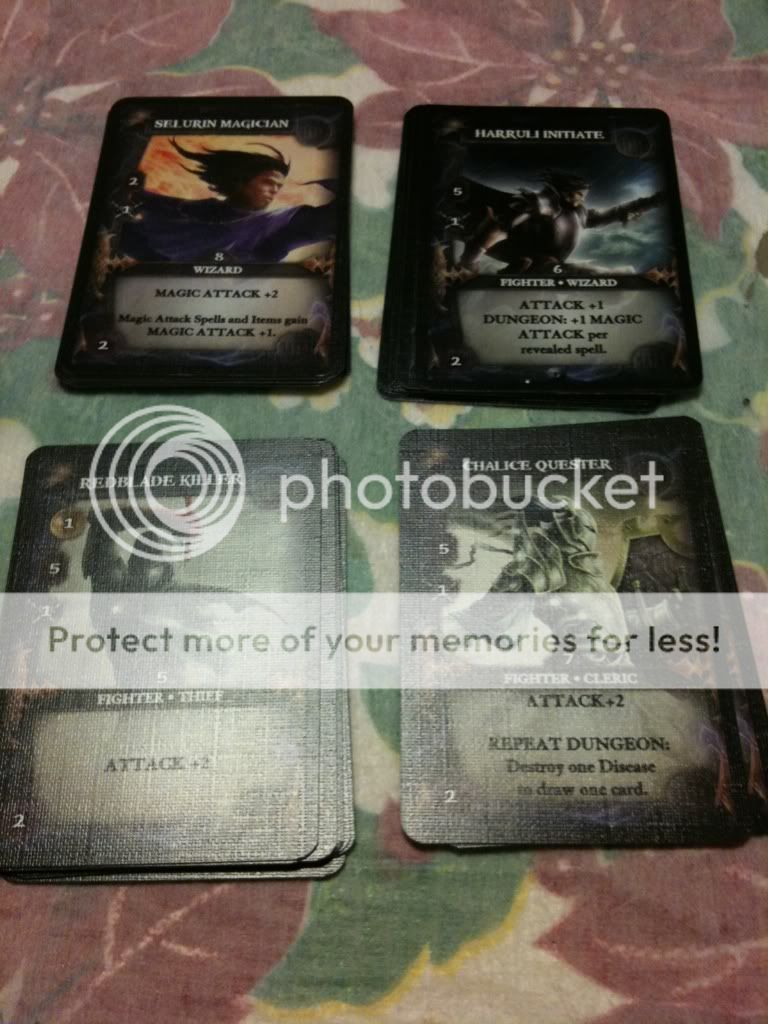
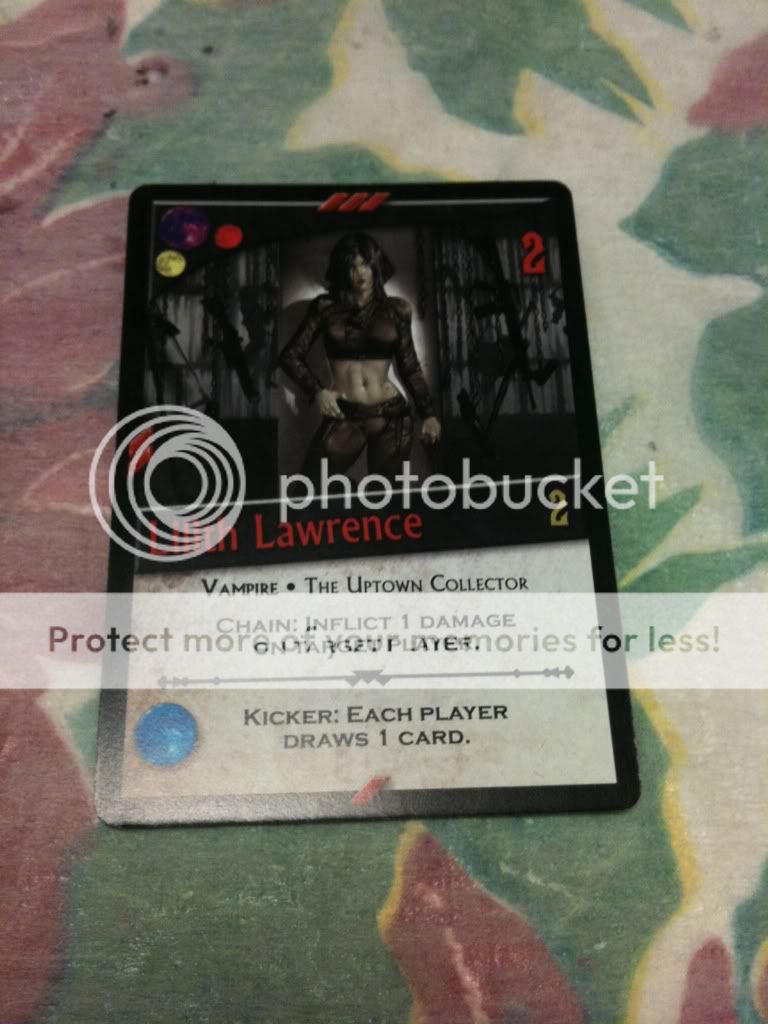
The premise behind the game is that each player (and you can have up to 5 playing) controls various creatures (minions), usually an assortment of Vampires, Werewolves and Hunters, and has powers (orders) that you use to overwhelm your opponents and thus win the game. Each player starts of a with a draw deck of 12 cards containing 2 each of the starting minions in the game-

The starting minions

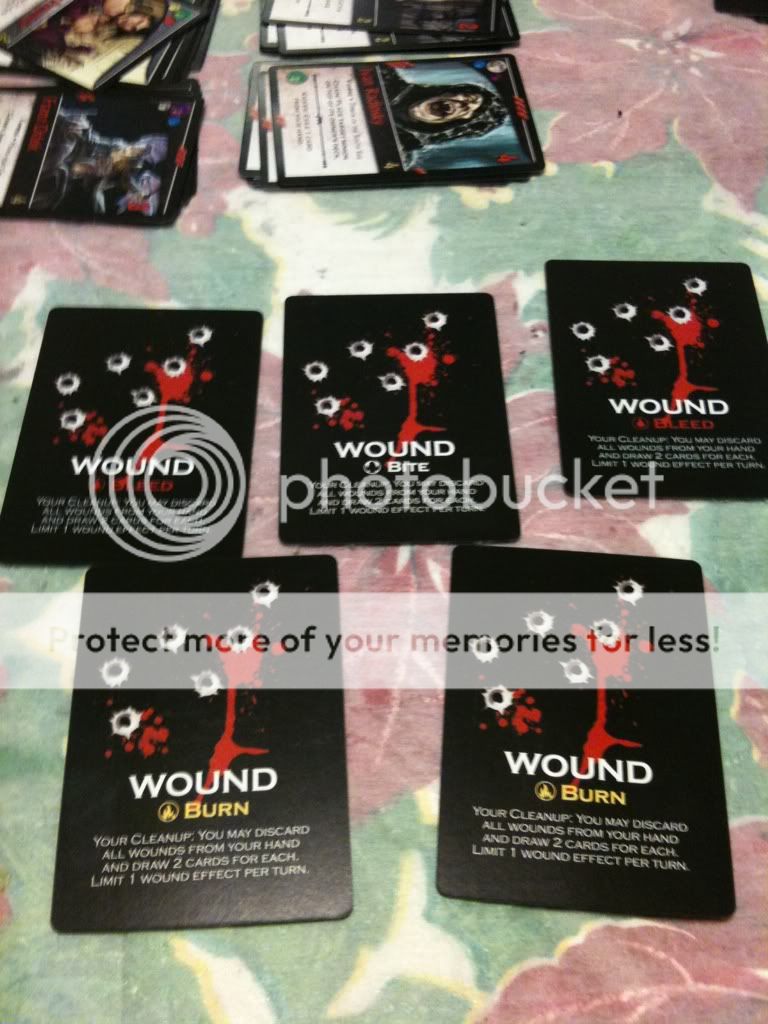
10 wound cards for each player in the game are turned face up and placed on top of the remaining face down wound cards. Each time a player takes damage he draws a wound card from this deck and places it into his discard pile. When all the face up wound cards are drawn then the game ends once play returns to the player who originally started the game. The player with the least wounds in his hand, draw deck or discard deck is declared the winner.


The Wound Cards


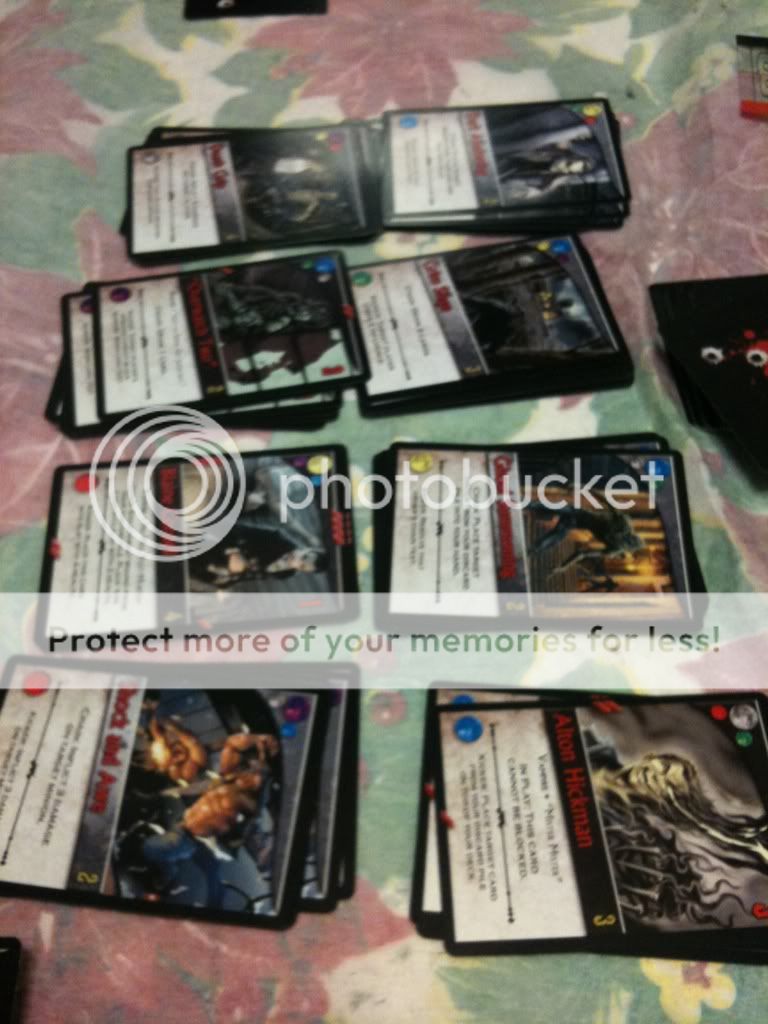
24 draft cards are then shuffled and each player is dealt 4 cards. The player selects one of those cards which will become his first "private" archive deck and as such only he (with limited exceptions due to card effects) will be able to use. The card are then passed round to the left and you then pick a second archive card. The cards are then passed round a third time and the card chosen this time forms part of the "Common" Archive from which all players will be able to access the cards. The remaining draft cards are discarded back into the box.

The Common Archive

Each player then draws 5 cards from his draw deck and after determining who goes first (we rolled a dice) the game begins.

"The 4 C phases"

Each player's turn is divided into 4 phases:- Combat phase, Chain phase, Claim Phase, Clean Up phase.

In combat, any minions that you have in play must attack. If they are sent against an opposing player then that player may either take damage equivalent to the strength of the minion (the red figure in the top right hand corner of the card), or use his own minions to block the attack. If the blocking minion absorbs all the damage (each minion has a health total which amounts to the number of hits it can take before leaving the table) then none is inflicted on the controlling player otherwise, hits not saved by blocking minions result in the target player drawing a wound for each hit. Any blocking minions destroyed by the damage inflicted go either into exile (that is they go back into the box) or on top of the discard pile (Marcus Toth actually goes into the player's hand).


Attacking minions are then, depending on their card text, put into exile or on top of the discard pile.

Then comes the "Chain Phase".

This is, in my opinion, one of the unique aspects of the game - at least I'm not aware of another game using this type of card playing mechanism.

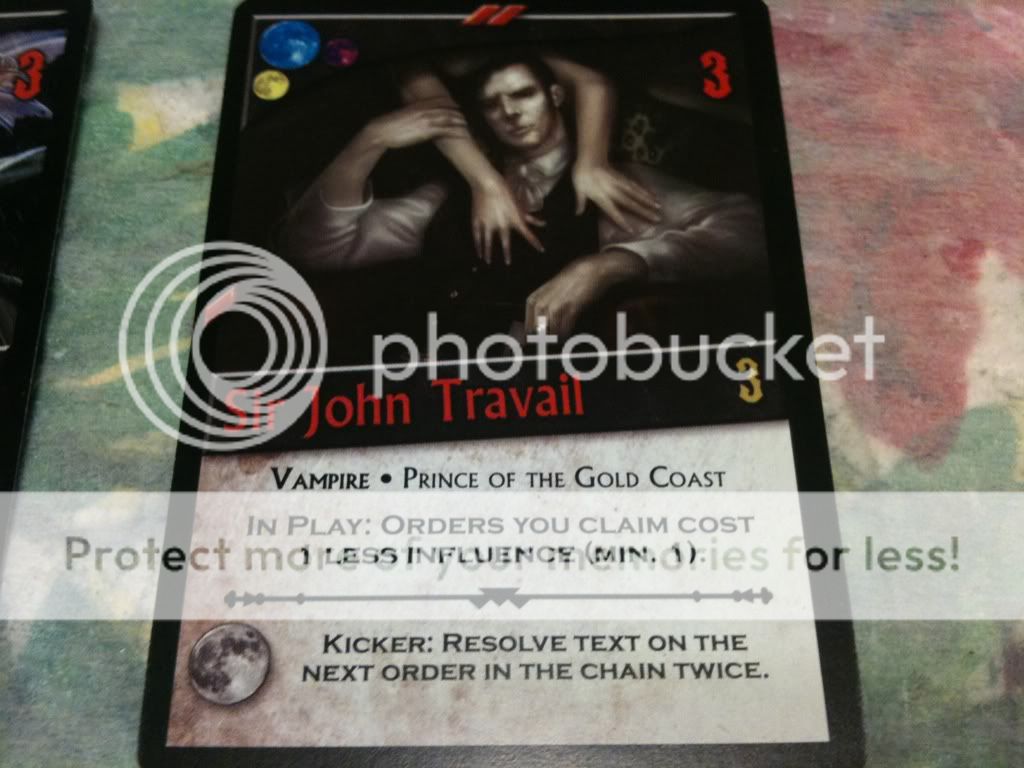
The active player, can choose to play 1 card as part of his starting chain. In the top left hand corner of the card will be 2 or 3 moon symbols, of different colours or perhaps the same colour. He can then play a card if the colour of the large moon symbol on the card matches one of the small coloured moons of the last card played in the chain. The player can continue adding to this chain of cards as long the colours match up. When he is done the player to his left can add cards to the chain and so on until play comes round to the first turn player again.


 So for example, if Sir John Travail is placed in the Chain first, the "Big Ghost" can then link to it next in the Chain as the colour of it's large Moon (Yellow) matches the colour of one of the small moons on Sir John's card.


Once all players have added to the Chain or passed, the Chain resolves, starting with the last card played on the Chain. Most of the cards, minion or an order, has a "Chain effect". As each card is removed from the Chain then the effect is resolved - it may be for example draw cards from your draw deck, or damage a target player and so on. As each effect resolves, the card, if it is a minion, is deployed to the table, if it is an order then it goes onto the player's discard pile.

In the claim phase, the player uses his "influence" to recruit cards from either his private archive decks or the Common archive decks. You start of with 2 influence per turn and cards can be discarded from hand to gain a point of influnce per card discarded. Each minion or order card has an "influence cost" - the yellow figure shown to the right of the Card Title and so you pay your influence and recruit the card, which is placed in the discard deck. So the card recruited is not immediately available to play.

The Clean Up phase allows a player to replenish his hand, discard wound cards to draw additional cards from his draw deck so that at the end of his turn he has a minimum of 5 cards in hand. As the starting draw deck is only 12 cards, the significance of placing the cards that you recruit with your influence into the discard pile becomes significant. You have to plan ahead and try and cycle through your draw deck as quickly as possible so that you can them empty it and your discard pile is then shuffled and becomes your new draw deck. (which is whay wound cards can end up in your draw deck and obviously then into your hand) Wounds can then be discarded from hand to allow you to draw 2 cards, thus increasing the cycling of the cards.

Play continues to the player on the left who rinses and repeats the sequence above until all the face up wound cards are drawn and the winner determined as I mentioned above.

So Alan, Jospeh and I sat down to the game. Although not totally sure of what was going on due to my limited skim through the rules, Alan (with Joseph's help) was able to summarise the mechanics of the game and the card effects for me fairly quickly and so the play commenced at a fairly frantic pace. Combat was joined, Chains formed, influence expended and after a wee while, after realising that Joseph and Alan tended to take large lumps out of each other and I was getting off lightly, I knew that I was in the lead. A big attack by me on Alan, meant he took so many wounds that he was clearly out going to end up last and a few more skilful card plays led to Joseph taking wounds and I ended up winning the first game with 6 wounds in total, Joseph's 8 and Alan's zillions (ok slight exaggeration).

That was fun, thought I, so let's go again, and so it was that Blood Bowl was forgotten about and we ended up playing 4 games and I won the first 3..... All hail the conquering hero!!

There are definite synergies to be worked out between the various cards to get the maximum effect from their text. Some of the starting minions have very useful abilities such as the "Bad Smoke" card which stops the player taking direct damage


And the Genesis One card can get rid of wound cards in your discard deck permanently


But as the starting minions are then Exiled into the box once they leave play and can't come back, their use has to be carefully planned. Using the Bad Smokes too early might give you space to build up your draw deck with good minions and orders but leave you exposed in the late game. But deploy them too late and you may have already taken to many wounds from which to recover. And playing the Genesis One card when there are no wound cards in your discard deck would normally be wasteful, but then if you have few minions available to you to help prevent an attack then you may have no option but to get the card in to play given that he has a health of 2.

So, perhaps not surprisingly, a lot of strategies to be worked out on how to get the best of the cards and again, because all of the cards are technically available to all of the players at the start of the game, there is no risk of a player bringing a deck to a game which contains all of the power cards of a set which he has acquired by spending much gold on eBay.

The physical components of the game are pretty sound, good solid box, card dividers, plenty of foam to protect the cards while in the box. Some excellent artwork


Hmmmmm, Charlotte, Fancy a Bite?

The rule book seemed pretty tight. We were able to find an answer to any query that cropped up fairly quickly. There is some background stories by Kenneth Hite which gave you an introduction to some of the characters who appear in the cards. Some of the cards contain keywords which don't have any relevance in this set but whch are clearly intended to have effect as other sets are released.

A copy of the latest rulebook and FAQ can be found here

One effect which didn't really come into play (whether that was due to us forgetting about it, or the card combinations not coming off, I'm not sure) was the "Kicker effect". Some cards have a Kicker effect whereby if the colour of the moon associated with the Kicker effect is the same colour as the Large Moon on the card in the Chain that you link to, then that Kicker effect will come into play when the Chain resolves. 

So an enjoyable game (it must have been given that I quite happily gave up a game of Blood Bowl for it) and given that Joseph, for all of his 9 years showed he grasped the mechanics of the game pretty quickly shows that it is definitely a game that can be learnt without too much brain crunching, and in my increasing dotage, I  I struggle to take in the rules after the first dozen or so pages.


So what happened in the last game? Well, Alan, in clear desperation to try and win a game (I think he had managed 1 second place up to that point) deployed his secret weapon - Japanese Rice crackers. Having kept me supplied with copious amounts of tea and soft drink through out the evening, the lure of the Japanese Rice Cracker was just too much temptation. I kept picking away at the box of crackers and munching happily that I was not keeping my eye on the play and got thumped with a couple of big hits from both Joseph and Alan, that I was not going to be able to recover from. So there was nothing else for it but to finish the crackers off.

I would have taken a picture of the offending crackers but I ate them all........


Thursday, 17 March 2011

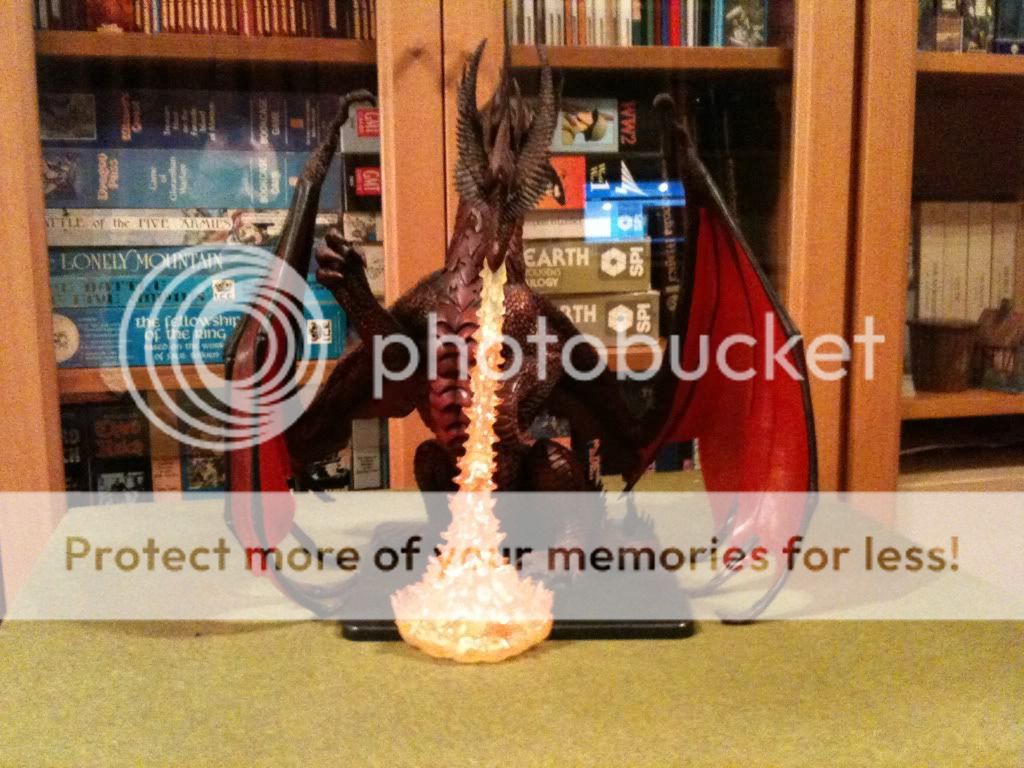
Colossican Ruber Draco - You can call him Big Red (Or Sir)


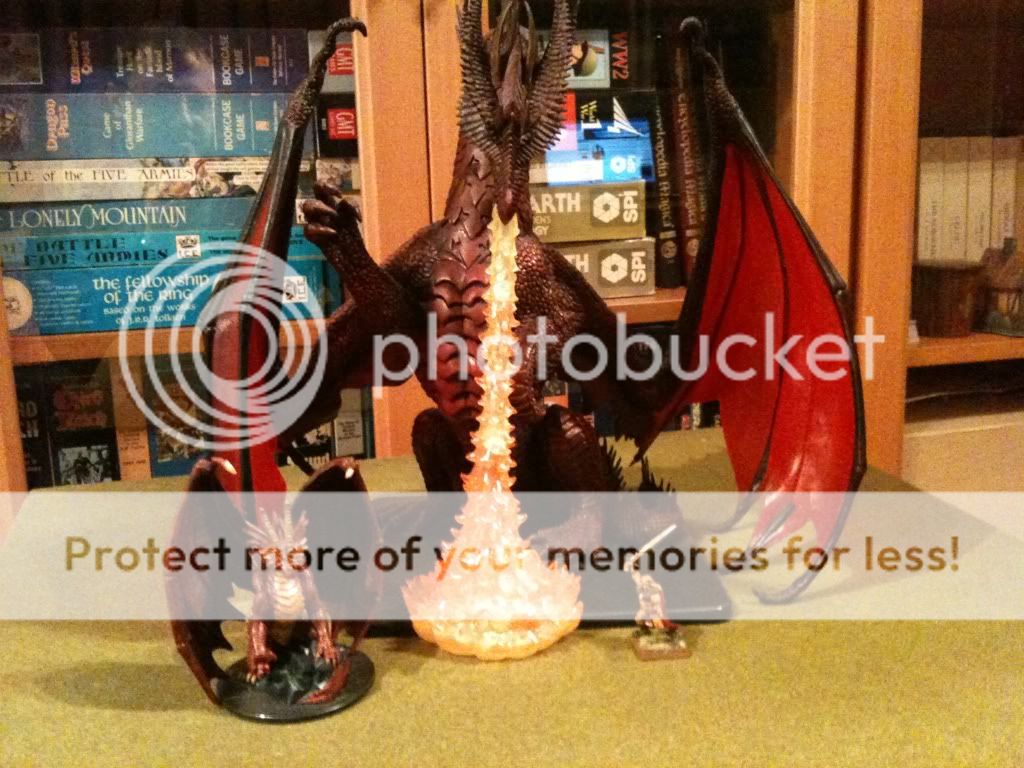
Just so you get an idea how big this bad boy is here is another picture of him with the Barbarian from Warhammer Quest standing next to him and the "Huge" Red Dragon from the Giants of Legend set released by Wizards of the Coast


The bad boy is, for those of you who don't know him, the Colossal Red Dragon which was released by Wizards of the Coast for their Dungeons and Dragons (D & D) skirmish game..........

As with a lot of projects, I sort of stumbled into the D & D Skirmish game. I think it must have been 2004 and for reasons I can't remember I gave Cammie a set of D & D figures from Wizards of the Coasts Collectible Miniatures series for his birthday. I don't know why, as Cammie hadn't played D & D (and still hasn't I think - is that correct Cammie?), but it was perhaps the fact that the minis were pre-painted, he would be able to game with them straight away as opposed to having to paint them himself.

Ok, those of you who have seen the D & D figures might regard the painting on some of the models pretty ropey and that is certainly very true but I thought they would be good enough for Cammie to play with. What I didn't realise at that time was that I had started on a very slippery slope which probably lasted for the best part of 3 years but during which time, I ended up spending a tidy sum on these toys.

The figures that I gave Cammie were from the Aberrations set that Wizards of the Coast had released the year before, for the skirmish game. It was at that time that a new edition of their rule book had been released with the set and as I read the rule book, I started thinking that this wasn't at all  a bad wee system, so started to look into more.

I had, of course, played D & D over the years - I still fondly recall getting the set of AD&D books for Xmas in 1982 and they were well used over the years as I ran a campaign for my pals Andy and Ian. But the figures we used for such roleplaying games were the models that I had bought, mainly from Citadel, and usually unpainted as I was so slow at painting. After University I drifted out of the Role-Playing scene partly because I didn't like the changes made to D & D by 2nd edition and partly because I now tended to play "proper" wargames. As a result I hadn't really kept tabs with what was happening in the D & D scene and by the time 3rd edition was released by Wizards, I didn't recognise it as being the same game I had played all those years ago. I knew vaguely that Wizards had started to produce their own line of figures but they had been universally panned (as were a lot of pre-painted ranges in those days) for being such dreadful paint jobs.

However, the premise of the game was pretty simple. You built a warband using models of any race as long as they were of one of the 4 alignments, Lawful Good, Chaotic Good, Choatic Evil or Lawful Evil. Each model had a point cost and usually you built a warband up to an agreed number of points - usually 200 and you could not normally include more than 8 figures in the warband. When the first edition of the rules came out, the board you played on was in fact a set of card tiles which you placed together to form your battleground, usually depicting some form of dungeon layout, but with the Aberrations set the system had moved to using pre-printed maps. The 2 warbands would fight it out on the map and the winner would be the first to score 200 points, either by wiping out the opponents war band and/or by occupying designated victory point areas on the map.

Each model came with a stat card upon which was given all the essential stats for movement (speed), hit points, Armour Class and the model's level - the higher the level the more powerful the model was deemed to be in the game. The card would also list the damage the model would do in combat (hand to hand and/or ranged and whether it also did magic damage) and also whether the model had any special abilites and spells. Little chits came with the starter set with which you could keep tabs of the damage the model had suffered until it lost all of it's hit points at which point it was removed from the game.

I must suffer from a compulsive disorder because once I started playing the game I was hooked and couldn't get enough of the game. My bro and I in November 2004 did a 10 hour overnight drive (me driving all the way as my bro can't drive) one Friday night from Arbroath to Bognor Regis so that we could attend Gencon UK on the Saturday morning and played D & D minis (DDM) all week end. And in 2006, my bro, Ruarok and I drove down to Birmingham to take part in the first ever European DDM Championships with about 60 players involved. Okay we didn't do very well but we did end up playing against people from various parts of Europe which was a great experience in itself.

I picked up the models, usually on Ebay, although my local friendly gaming store in Dundee - Highlander Games - did stock some boosters from time to time and I would pick up some there. And that, of course, was the big bugbear with the range - like many collectible games before and since, you were blind and had no idea  what was in a booster until you opened it, other than you would get 1 rare figure, 1 uncommon and 6 common figures. And like many other collectable/ tradeable systems the best pieces were usually (though not always) the rare ones.

Even though the game had only been out for a couple of years, models from the first set "Harbinger" (the one that had been so heavily criticised on it's release) were already out of production and difficult to get hold of. But from an early stage of getting into the game I decided that rather than trying to collect all of the figures - which would have been a quick way to the divorce courts, I would try and get, where possible all of the Dragon figures that Wizards released in the range.


Well it was a good effort but in the end even I had to admit defeat. With the release of the Dungeons of Dread set in March 2008 which was the 15th set that Wizards had released in just over 5 years, my enthusiasm had started to wane (too many Dragons!!) and with that release came another major change to the rules and the way the game played, in theory, to make it compatible with 4th Ed D & D which had just been released, so it was time to bow out. As it was, only a few sets later, Wizards then changed the format again and released the Dangerous Delves set in May 2009, which was the first open set, in that you could see the minis you were buying but no skirmish rules were released with that set as Wizards had announced that they were no longer supporting the skirmish side of the game. How much the game had fallen came home to me hard when at Game 09 in Manchester, when bro, Ruarok, Cammie and I went down to play Blood Bowl in the Tritex Blood Bowl challenge. The European DDM event was also being held there at the same time and I was sorry to see that there were probably less than 15 players taking part.

The final death knell for the game came in January this year when Wizards announced that were, with immediate effect, dropping their entire miniatures range. I admit to having a wee sentimental tear in my eye at the news.

Wizards, despite their announcement, have not totally abandoned the mini and with the release of their Wrath of Ashardalon  board game, which looks like a cross between Warhammer Quest and D & D, the figures in that game look very similar to some old departed friends

And yet, despite the Dragon Mania, the favourite D & D figure I have is in fact:-

Don't mess with the Eye Tyrant!!